Understanding Voltage Drop: A Definitive Guide for Series and Parallel Circuits
What Is Voltage Drop In Parallel And Series Circuits?
Voltage drop refers to the reduction in electrical potential energy across a component or along a conductor as current flows, caused by the inherent resistance of the material. A precise understanding of what is voltage drop in parallel and series circuits is fundamental for proper system design, ensuring efficient power delivery, and preventing detrimental effects on connected loads.
Key Concepts for Analyzing Voltage Drop
Effective analysis of voltage drop necessitates a firm grasp of several foundational electrical principles. These concepts are indispensable for diagnosing issues and designing robust electrical systems.
- Electrical Resistance (R): The opposition to the flow of electric current. All conductors, even wires, possess some degree of resistance, which dissipates energy as heat and contributes to voltage drop.
- Electric Current (I): The rate of flow of electric charge. Current is the driving factor behind voltage drop; without current, there is no drop across a resistance.
- Voltage (V): The electrical potential difference that drives electric current. Voltage drop is the reduction of this potential from one point to another in a circuit.
- Ohm's Law (V = I x R): This fundamental law describes the relationship between voltage, current, and resistance. It is the primary tool for quantifying voltage drop across a specific resistance.
- Power (P = V x I): The rate at which electrical energy is transferred. Excessive voltage drop can lead to significant power losses, reducing system efficiency and potentially affecting component performance.
- Circuit Configuration: The arrangement of components, specifically whether they are connected in series or parallel, dramatically alters how voltage drop manifests throughout the circuit.
Understanding the Path of Current and Voltage Drop in Circuit Configurations
The behavior of current and the manifestation of voltage drop differ significantly between series and parallel circuit configurations. A clear understanding of these dynamics is crucial for any electrical system analysis.
- Current Originates from the Source: In any circuit, current emanates from the positive terminal of the power source, flows through the circuit, and returns to the negative terminal, completing the loop.
- Voltage Drop in Series Circuits:
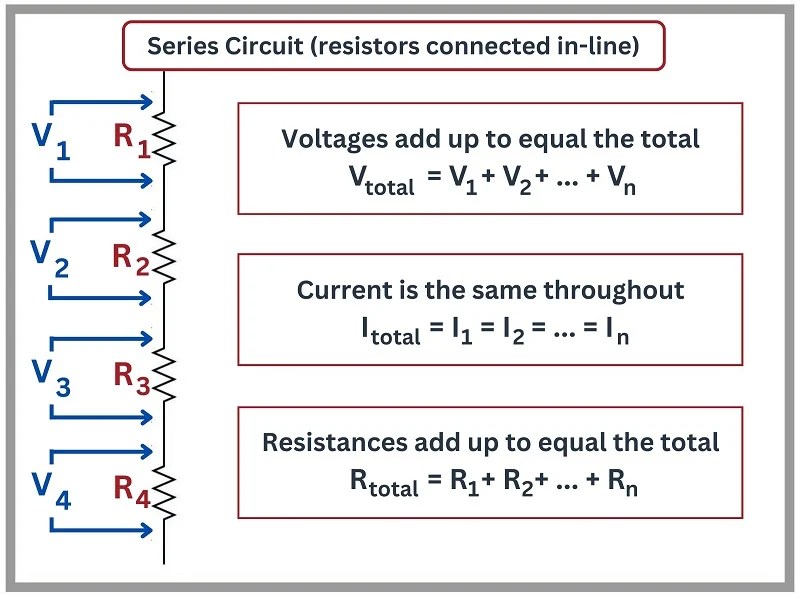
- Current Consistency: In a series circuit, the current is the same at every point. It flows sequentially through each component.
- Voltage Division: The total voltage supplied by the source is divided among the components. As current passes through each resistive element (a wire, a resistor, a lamp), a portion of the voltage is "dropped" across it. The sum of all individual voltage drops equals the total supply voltage.
- Cumulative Effect: The voltage reaching subsequent components progressively decreases, meaning a load placed later in a long series string will experience a lower operational voltage than one closer to the source, assuming identical resistance in the connecting wires and components. This illustrates what is voltage drop in parallel and series circuits, specifically in series.
- Voltage Drop in Parallel Circuits:
- Voltage Consistency Across Branches: In a parallel circuit, each branch connected across the main supply experiences the full source voltage, ideally.
- Current Division: The total current from the source divides among the parallel branches, with the amount in each branch inversely proportional to its resistance.
- Conductor Drop is Critical: While ideal parallel components see the same voltage, voltage drop primarily occurs along the connecting wires that supply these parallel branches. If the supply wires themselves have significant resistance, the voltage available to all parallel branches will be reduced as current flows through these common conductors. The cumulative current of all parallel branches flowing through a shared feeder wire will exacerbate this common conductor voltage drop.
- Impact on All Loads: A significant voltage drop in the main supply lines of a parallel circuit will affect all connected loads equally, reducing the voltage delivered to every branch simultaneously. This further clarifies what is voltage drop in parallel and series circuits, emphasizing the unique aspects of parallel configurations.
- Return Path: After passing through the loads, current returns to the source. Any resistance in the return wiring also contributes to voltage drop, reducing the total voltage delivered to the load.
Troubleshooting and Mitigating Voltage Drop Issues
Unacceptable voltage drop can manifest as a range of operational problems, from reduced performance to outright component failure. Addressing these issues effectively requires a systematic approach.
Common Symptoms of Excessive Voltage Drop
- Dim or Flickering Lights: Insufficient voltage prevents lamps from operating at their rated brightness.
- Slow or Stalling Motors: Electric motors require specific voltage levels to generate adequate torque. Reduced voltage leads to decreased speed, overheating, and potential failure.
- Malfunctioning Electronics: Sensitive electronic devices are often designed for narrow voltage tolerances. Significant voltage drop can cause erratic operation or permanent damage.
- Overheating Wires and Connectors: When current flows through resistive wires, energy is converted to heat. If voltage drop is high, indicating significant resistance, the wires can overheat, posing a fire risk.
Strategies for Mitigation and Resolution
Addressing voltage drop involves reducing the overall circuit resistance or the current, or both.
- Increase Wire Gauge: Thicker wires (lower American Wire Gauge or AWG number) have less resistance per unit length. Upgrading undersized wiring is the most common and effective solution for mitigating voltage drop.
- Shorten Wire Lengths: Resistance is directly proportional to conductor length. Minimizing wire runs reduces total resistance and, consequently, voltage drop.
- Reduce Current Draw: If practical, reducing the load (e.g., using lower-wattage appliances, fewer devices) will decrease the current, which in turn reduces voltage drop according to Ohm's Law (V_drop = I x R_wire).
- Utilize Higher Supply Voltage (where applicable): For long-distance power transmission, stepping up the voltage reduces current for a given power level, thereby minimizing I²R losses and voltage drop. Transformers are then used to step down the voltage at the load end.
- Improve Connections: Loose, corroded, or poorly crimped connections add resistance to a circuit. Regularly inspecting and ensuring secure, clean connections can significantly reduce localized voltage drops.
- Add Dedicated Feeder Circuits: For parallel circuits experiencing high cumulative current draw, installing additional, dedicated circuits from the power source can reduce the current flowing through any single set of feeder wires, thus lowering voltage drop.
Warnings and Safety Risks Associated with Voltage Drop
While often perceived as an efficiency problem, excessive voltage drop can escalate into significant safety hazards and cause irreversible damage.
- Fire Hazard: High resistance, which is the root cause of voltage drop, generates heat when current flows. Sustained overheating in wires, terminals, or components can degrade insulation, melt conductors, and ignite surrounding materials, leading to fires.
- Component Damage and Reduced Lifespan: Operating electrical devices below their specified voltage range can cause them to draw excessive current, overheat internally, or function inefficiently, leading to premature failure and increased maintenance costs.
- Electrocution Risk: Damaged insulation from overheating wires, often exacerbated by excessive voltage drop conditions, can expose live conductors, creating a direct electrocution hazard for personnel.
Frequently Asked Questions About Voltage Drop
What is the acceptable percentage of voltage drop in electrical circuits?
Industry standards typically recommend a maximum voltage drop of 3% for feeder circuits and 5% for combined feeder and branch circuits. However, specific applications, especially those involving sensitive electronics or motors, may require even tighter tolerances to ensure optimal performance and longevity.
How is voltage drop calculated for a simple circuit?
Voltage drop can be calculated using Ohm's Law. For a wire, the formula is VD = I × R, where VD is the voltage drop, I is the current flowing through the wire, and R is the total resistance of the wire (including both the supply and return paths). The wire resistance (R) depends on its material, length, and gauge.