Understanding Sequential Circuits: A Comprehensive Analysis of Their Types and Operational Principles
Sequential circuits represent a fundamental class of digital logic systems defined by their ability to store information and for their output to depend not only on the present inputs but also on the sequence of past inputs. This memory characteristic enables complex state-dependent operations, distinguishing them from combinational circuits whose outputs are solely a function of current inputs. Understanding What Are The Types Of Sequential Circuits is paramount for designing robust digital systems.
Core Components and Foundational Types of Sequential Circuits
The architecture of sequential circuits relies on specific memory elements and their interconnection with combinational logic. The primary building blocks and categories that define What Are The Types Of Sequential Circuits include:
- Latches (e.g., SR Latch, D Latch, Gated D Latch)
- Flip-Flops (e.g., D Flip-Flop, JK Flip-Flop, T Flip-Flop, SR Flip-Flop)
- Registers (e.g., Shift Registers, Parallel Load Registers)
- Counters (e.g., Asynchronous Counters, Synchronous Counters)
- State Machines (e.g., Mealy Machines, Moore Machines)
Operational Principles and Design Considerations for Sequential Circuits
The operational integrity of sequential circuits hinges on a precise flow of information and controlled state transitions. Understanding this flow is crucial for designing reliable systems.
-
Input Signal Acquisition:
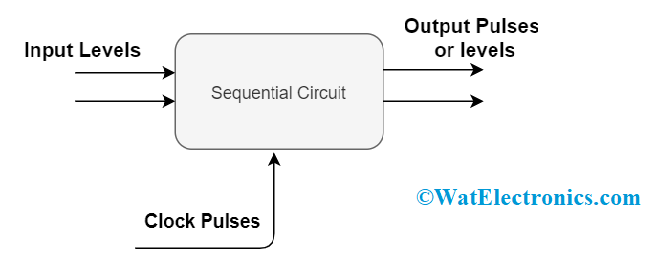
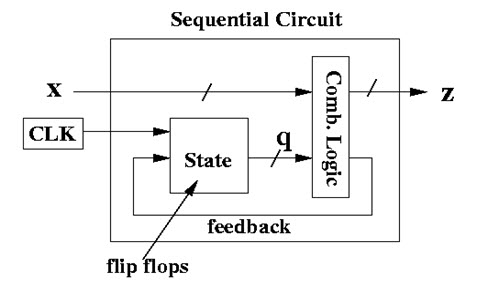
External inputs are received by the combinational logic component of the sequential circuit. These inputs, along with the current state feedback, determine the next state and potentially the current output.
-
Current State Feedback:
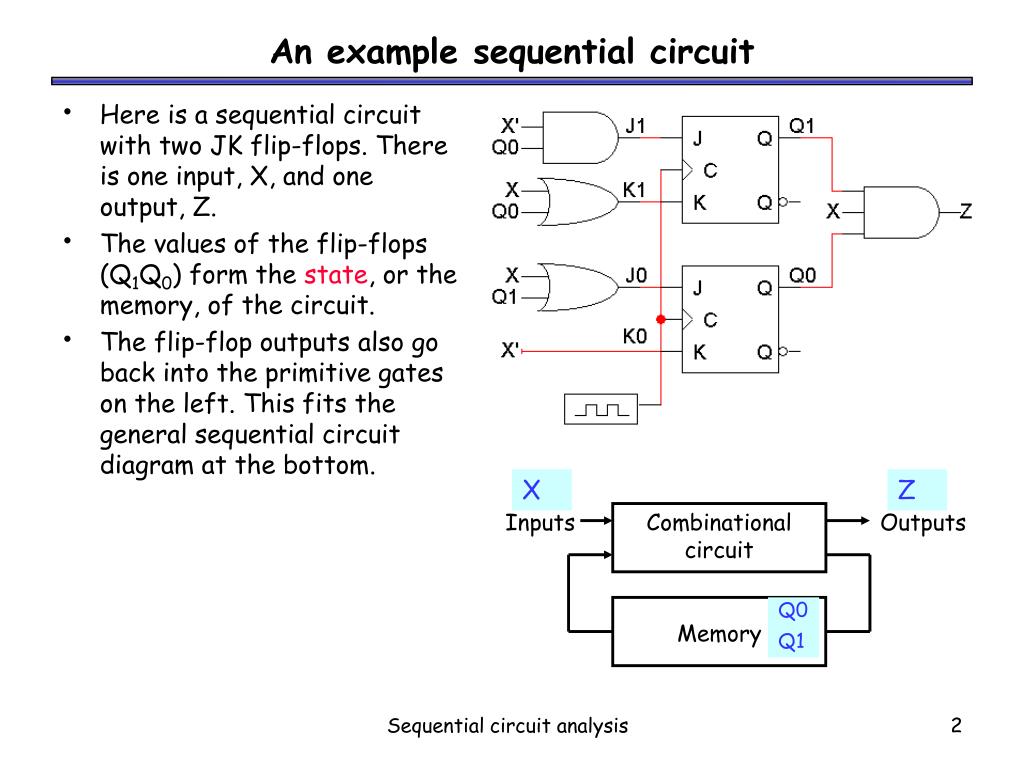
The outputs of the memory elements (latches or flip-flops) represent the current state of the circuit. This current state information is fed back as an input to the combinational logic, influencing its computations.
-
Next State Computation:
The combinational logic processes the current external inputs and the current state feedback to compute the 'next state' signals. These signals indicate what the new state of the memory elements should be after the next clock event or enable signal.
-
Clock or Enable Signal Propagation:
A clock signal (for synchronous circuits) or an enable signal (for latches) dictates when the memory elements will update their stored value. This signal ensures synchronized state changes across the circuit, preventing erratic behavior.
-
State Update in Memory Elements:
Upon the active edge of the clock (for edge-triggered flip-flops) or when the enable signal is active (for latches), the memory elements capture the 'next state' computed by the combinational logic. This becomes the new 'current state' for the subsequent cycle.
-
Output Generation:
Depending on the design (Mealy or Moore machine), the circuit's outputs are generated by the combinational logic based on either the current state alone (Moore) or a combination of the current state and current inputs (Mealy). These outputs provide the desired response of the system.
What Are The Types Of Sequential Circuits: An In-Depth Examination
A detailed examination of What Are The Types Of Sequential Circuits reveals distinct characteristics and applications for each category, forming the backbone of digital system design.
Latches
Latches are fundamental asynchronous memory elements, meaning their state can change as soon as the inputs change, provided the enable signal is active. They are level-sensitive, updating when their control input is at a specific logic level (high or low). Common types include the SR Latch (Set-Reset), which can set or reset its output, and the D Latch (Data Latch), which stores the input data when enabled. While simple, their level-sensitive nature can introduce timing issues like racing conditions in complex synchronous systems, leading to their predominant use in simple control applications or as components within flip-flops.
Flip-Flops
Flip-flops are the synchronous counterparts to latches, distinguished by their edge-triggered behavior. They update their state only on a specific transition (rising or falling edge) of a clock signal, providing precise timing control essential for complex digital systems. This characteristic mitigates race conditions and simplifies synchronization. Key types of sequential circuits categorized as flip-flops include:
- D (Data) Flip-Flop: The simplest, it transfers the input D to the output Q on the active clock edge. It is crucial for data storage and creating registers.
- JK Flip-Flop: A versatile flip-flop, it can set, reset, or toggle its output based on its J and K inputs. When J=K=1, it toggles, making it useful in counters.
- T (Toggle) Flip-Flop: Created by connecting the J and K inputs of a JK flip-flop together, it toggles its output state with each active clock edge when T=1. It is primarily used in counters and frequency dividers.
- SR (Set-Reset) Flip-Flop: Similar in function to the SR latch but edge-triggered. It is less common in modern designs due to its indeterminate state when both S and R are active.
Flip-flops are the building blocks for registers, counters, and other complex sequential logic.
Registers
Registers are groups of flip-flops used to store multiple bits of binary data. Their primary function is temporary data storage within a CPU or digital system. What Are The Types Of Sequential Circuits that fall under registers include:
- Parallel-Load Registers: All bits are loaded simultaneously on a single clock edge.
- Shift Registers: Data can be shifted serially, bit by bit, either left or right. They are essential for serial-to-parallel or parallel-to-serial data conversion, as well as for various arithmetic operations.
Counters
Counters are sequential circuits designed to cycle through a predetermined sequence of states. They are integral to timing, frequency division, and event counting. What Are The Types Of Sequential Circuits classified as counters include:
- Asynchronous (Ripple) Counters: The output of one flip-flop serves as the clock input for the next, leading to propagation delays that 'ripple' through the stages. They are simpler but slower and suffer from decoding glitches.
- Synchronous Counters: All flip-flops are clocked simultaneously by a common clock signal. This eliminates ripple delays, making them faster and more reliable, albeit with more complex combinational logic for state transitions. Examples include ring counters and Johnson counters.
State Machines
State machines, also known as finite state machines (F